
PRESS RELEASE 2026-03-30
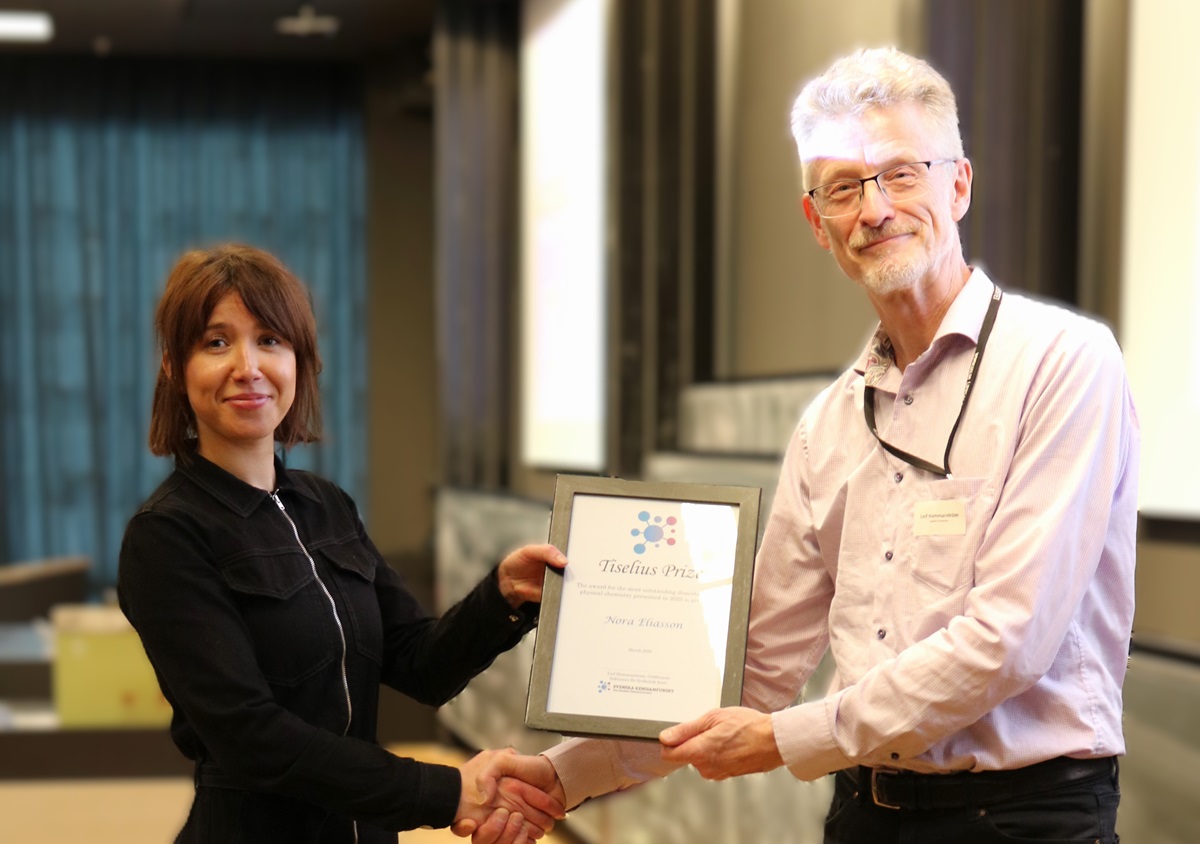
Nora Eliasson is the second receiver of the Tiselius Prize in physical chemistry. She received the prize for her dissertation Quantum Dot–Molecular Hybrid Systems for Solar Energy Conversion, which she defended at Uppsala University on the 21st of February.
Nora’s research focuses on quantum dots – nanoparticles so small that their properties are governed by quantum effects, which vary with their size. For example, the color of quantum dots changes depending on how large they are.
Can you describe your research?
– I have been working on hybrid systems combining quantum dots and molecules to convert solar energy into useful chemical or electrical energy. The idea is to combine the favorable light-harvesting properties of inorganic semiconductors, particularly in the quantum-confined size regime, with the tunability and catalytic selectivity offered by molecular structures. My research focuses particularly on understanding ultrafast processes in these systems, so basically investigate what happens in these systems immediately after light absorption, using ultrafast spectroscopic techniques.
How did you become interested in quantum dots?
– My interest in quantum dots began during my master’s studies at Uppsala University. When choosing a project, my supervisor suggested working on either perovskite materials or quantum dots. I remember thinking it would be fun to title a perovskite project “Shining light on a perovskite”. I still think it’s a great title, because rhymes are fun. In the end, however, quantum dots won me over.
How did you decide to work with chemistry?
– I have always been curious about the natural sciences, particularly physics and chemistry. This interest started at a young age, and I often spent my free time reading popular science books. When I began my bachelor’s program, I was initially drawn to neurochemistry. But over time I became increasingly fascinated by physical chemistry, particularly in understanding chemical systems from a more “bottom-up perspective”, or from the underlying principles that govern their chemical behaviour, and build my understanding from there. I also grew increasingly curious about experimental techniques like laser spectroscopy.
Is there anything from your time as a PhD that you are particularly proud of?
– That is a difficult question. Rather than pointing to a single project or achievement, I am most proud of the journey as a whole. It is a remarkable experience to realize that, with persistence and focus, you can develop a deep understanding of complex subjects and learn to use techniques that initially seem almost impossible to master.
How does it feel to be done with your PhD?
– “Sappy” might be the right word (both sad and happy at the same time). I feel incredibly lucky to have been surrounded by such supportive, talented, and driven people in a curiosity-driven environment. I will truly miss the stimulating discussions and the many enjoyable moments we shared. At the same time, I feel excited and curious about what lies ahead!
What is the next step for you?
– I have accepted a position as a scientist at a research institute. I am very excited to continue as an experimentalist, even though the context will be quite different. I will always be a physical chemist at heart, and I look forward to bringing that perspective to the group!
Do you have a favorite historical chemist? – There are many scientists, chemists and others, who have inspired me. At home, I have a book series titled “Nobel Lectures Chemistry,” which has been a great source of inspiration. Figures such as Pauling, Nernst, Ostwald and Langmuir are all well recognized names. And the great Curie of course. From Uppsala’s own history, I would mention Tiselius, Svedberg and Arrhenius. I have also enjoyed reading more popular science books by Prigogine. In photochemistry, Ciamician stands out with his rather philosophical texts, and more broadly, works by scientists like Sagan, Schrödinger and Feynman, have all been very enjoyable.
How does it feel to be awarded the Tiselius Prize?
– I am deeply grateful and honored. I would like to sincerely thank the committee at the Swedish Chemical Society, and all my colleagues and supervisors who have supported me throughout the years. This prize is a wonderful initiative that highlights the value of dedication and hard work. While I am the lucky one receiving it this year, I know that many of the people I have had the privilege of working with are equally deserving.
The award ceremony took place during the Svedberg Centennial workshop – Physical Chemistry 2026, at the Ångström Laboratory, Uppsala University on 19-20 March. The event was organized in honor of The Svedberg’s Nobel Prize in Chemistry in 1926.
The Tiselius Prize
The award is named after Arne Tiselius, who earned his doctorate in physical chemistry from Uppsala University in 1930. His supervisor was Theodor Svedberg, and the focus of his dissertation was electrophoresis. Using this technique, Tiselius became the first to successfully separate blood proteins. He later continued to develop electrophoresis, primarily with a focus on biochemistry. He was awarded the Nobel Prize in Chemistry in 1948.The Tiselius Prize was founded by the Division of Physical Chemistry, Swedish Chemical Society, and was first handed out in 2025. Read more about the Tiselius Prize here.
Contact:
Agnes Rinaldo-Matthis, Swedish Chemical Society
agnes.rinaldo.matthis@kemisamfundet.se